
I am interested in how medieval Europeans dealt with sanitation problems in the growing urban areas. My primary focus has been waste handling and disposal choices and their effects on streets, empty plots, and waterbodies in the cities and towns.
Medieval cities –
Not as dirty as we think.
Muck and filth cleaned up.
(my dissertation haiku posted on Dissertation Haiku)
- Crafts and Cleanliness: The Regulation of Noxious Business Activity in English Towns During the Fourteenth through Sixteenth Centuries
 Through a study of English town government sources, this chapter argues that local authorities in the fourteenth through sixteenth centuries regulated craft businesses with an eye on their outputs to the environment that could have detrimental health effects. Textile manufacturing, leather working, and brewing—three significant urban craft activities—were the target of environmental urban laws. Although …
- Blood on the butcher’s knife
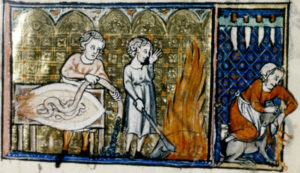 The late medieval period has complex and contradictory developments in the thinking about animal blood from butchery. It is both a potential pollutant to watercourses and soil, as well as a valuable ingredient in food for human consumption as blood pudding. It is a practical necessity, but also infused with spiritual meaning. During the late …
- Modernity and medieval muckNature + Culture 9 (2014): 225-237 This article challenges the common presentation of the medieval street as a mud- and muck-filled cesspit. Using the television episode “Medieval London” of the Filthy Cities series aired by BBC Two in 2011 as a spring board, I discuss the realities of medieval waste management and modern conceptions of it. …
- The medieval sense of smell, stench, and sanitationIn Les cinq sens de la ville du Moyen Âge à nos jours, ed. Ulrike Krampl, Robert Beck and Emmanuelle Retaillaud-Bajac (Tours: Presses Universitaires François-Rabelais, 2013), 301-313. Although linking smell and sanitation has been previously discussed by scholars as an early modern development, this article argues that controlling smells from human and animal wastes was a …
- City sanitation regulations in the Coventry mayor’s proclamation of 1421Arcadia: Online Explorations in European Environmental History, 2012. Access the article online in Arcadia (free)
- The Metamorphosis of Ajax, jakes, and early modern urban sanitationEarly English Studies, 2010, online. This article examines Sir John Harington’s A New Discourse of a Stale Subject, Called The Metamorphosis of Ajax through the lens of urban environmental history, examining the everyday context of Harington’s discourse. It argues that although Harington may have used the work for the political and social commentary discussed by other scholars, …
- What to do with waste? The challenges of waste disposal in two late medieval townsin Living cities: An anthology in urban environmental history, ed. Matthias Legnér and Sven Lilja (Stockholm: Forskningsrådet Formas, 2010), 34–55. Living in an urban setting comes with a price. Waste disposal in these crowded settings often becomes a problem. In the late medieval towns of York and Coventry, the town councils recognised and attempted to address …
- Local government responses to urban river pollution in late medieval EnglandWater History 2.1 (2010), 35-52. This article examines the local responses to medieval urban river pollution in three leading English towns—Coventry, Norwich, and York—during the late fourteenth through sixteenth centuries. The case studies reveal the extent to which local governments became involved in river upkeep. Interventions by the town governments were twofold: (1) preventative actions in …
- ‘All good rule of the Citee’: Sanitation and civic government in England, 1400-1600Journal of Urban History 36.3 (2010), 300-315. This article examines how providing one basic city service—sanitation—influenced civic governmental structures from 1400 to 1600 in two of England’s largest provincial cities, Norwich and Coventry, and how those changes meshed with concepts of good rule. Although sanitation services were neither the most costly nor the highest profile …
- Cooperative sanitation: Managing streets and gutters in late medieval England and ScandinaviaTechnology and Culture 49.3 (2008), 547-567. This article investigates the workings of sanitation technologies in late medieval English and Scandinavian cities through both written and archeological evidence. It defines the roles of city corporations and individuals in the areas of street maintenance and waste management between the years 1350 and 1550. It argues that although the …
- Private need, public order: Urban sanitation in late medieval England and ScandinaviaPhD Dissertation, University of Virginia, 2008, directed by W. B. Carlson. This study investigates the workings of late medieval sanitation technologies, particularly how solutions to sanitation issues were constructed as a relationship between the city government and urban inhabitants. It argues that medieval sanitation developed through the reciprocal interaction between physical conditions and complex social …
- Medieval latrines and the lawMedium Aevum Quotidianum 53 (2006), 5-16. This article analyzes two types of latrine regulation in far northern Europe during the medieval period: latrine placement and waste disposal. It shows that latrines in the later fourteenth through mid-sixteenth centuries were very much within the public sphere. Public regulation of latrine placement and waste disposal was required to …
- Podcasts in medieval environmental historyI have discussed medieval environmental history as a discipline and my own work in the field in two podcasts: 2013, Umeå Group for Premodern Studies and 2009, Environmental History Resources (scroll down to podcast #28).
- Book reviews about sanitationReview of Linda Clark and Carole Rawcliffe, eds. Society in an Age of Plague (Woodbridge: Boydell Press, 2013), Speculum 90, 526–528. Available from journal “Decoupling Water and Sanitation,” a review of Maggie Black and Ben Fawcett, The Last Taboo: Opening the Door on the Global Sanitation Crisis (London: Earthscan, 2008). Available on H-Net “Putting Dirt in Its Place,” …
- Public dissemination (sanitation)Interviewed for magazine article “Urban Livestock: A Tender Issue”, New West Magazine, Feb 11, 2008. Read it online. A feature article about my research and its inclusion of Scandinavian archeology appeared in Norwegian in the forskning.no online magazine in June 2007. Read it online.
Pingback: Our lives are linked to land and water | Velcro City Tourist Board
Pingback: Perception of risk of harm – The Return of Native Nordic Fauna
Pingback: Medieval Public Health – Thinking History