
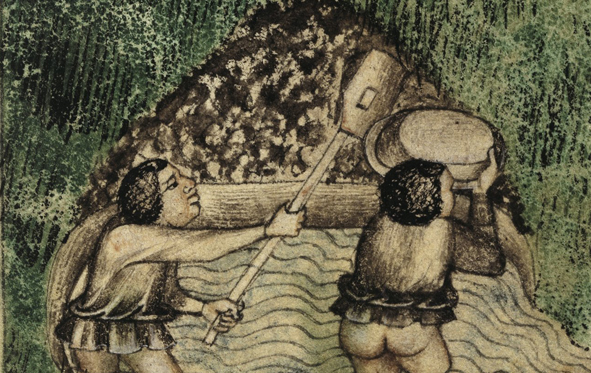
I am interested in how people in medieval Europe have managed various resources to make the most of their potential. I have looked extensively at agricultural landscapes and the environment in the early Anglo-Norman period (1066-1135) in England and Normandy. I have also published on swine husbandry and agricultural practice in the High and Late Middle Ages in both city and countryside.
- Om GriserI appeared on the podcast Bildningspodden from Sweden in December 2025 talking about medieval pigs. A description of the podcast: Grisen är intimt förknippad med julen, och inte bara som julskinka. Men så har svinet en lång och vindlande kulturhistoria, från Odysséen till Hollwood. Också som djur är de ovanligt intressanta, enligt många djurforskare. Men …
- Talking Medieval Pigs
 I had the chance to talk with the folks over at the Museum of English Rural Life (MERL) about medieval pigs. There are two podcast episodes to listen to: Medieval Pigs and The Meaning of Pigs
 - The Medieval Pig
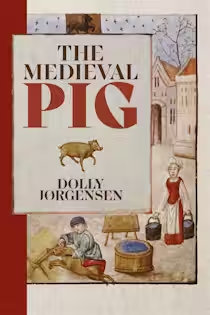 The pig was a common sight in the Middle Ages. They might be eating under an oak tree, or out in a field. They might be in the street, with the swineherd close behind at their heels. They might be dismembered, for sale by a butcher. They might be represented on misericords, in a church …
 - Controlling Pigs in Countryside and City for Sustainable Medieval Agriculture
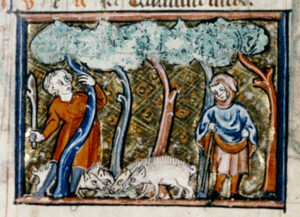 Domesticated pigs (Sus scrufa) were an integrated component of medieval food production in both city and countryside. This chapter examines strategies for managing pigs in a sustainable fashion in the Middle Ages, with a focus on England and neighbouring Normandy. The chapter argues that limitations were placed on where, when, and how many swine were …
 - Blood on the butcher’s knife
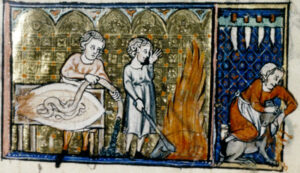 The late medieval period has complex and contradictory developments in the thinking about animal blood from butchery. It is both a potential pollutant to watercourses and soil, as well as a valuable ingredient in food for human consumption as blood pudding. It is a practical necessity, but also infused with spiritual meaning. During the late …
 - Illuminating Ephemeral Medieval Agricultural History through Manuscript Art
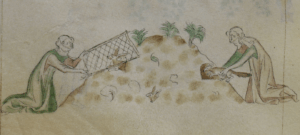 There are objects and practices we would not know existed if we relied only on written texts or archeological evidence to piece together medieval agricultural history. These ephemeral aspects of the agricultural past are sometimes, however, captured in art. This essay explores some of the possible ways to recover fleeting history using medieval illuminations, which …
 - Podcasts in medieval environmental historyI have discussed medieval environmental history as a discipline and my own work in the field in two podcasts: 2013, Umeå Group for Premodern Studies and 2009, Environmental History Resources (scroll down to podcast #28).
- The origins and history of medieval wood pastures
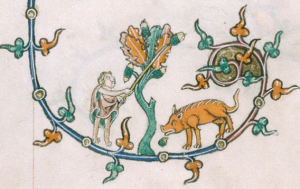 Rather than historical ecology, which is the study of what the environment was at a particular moment in time, this chapter presents an environmental history, which is the study of the interactive relationship between humans and non-human nature in the past. This chapter does not attempt to reconstruct the quantity, quality, or composition of wood …
 - The enduring landscape of medieval cathedral construction
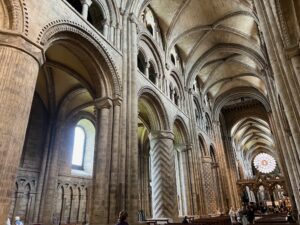 This paper examines the great building phase of the Anglo-Normans in England from an environmental rather than the more common architectural standpoint. THe construction of massive cathedrals, modern monasteries, and ubiquitous parish churches resulted in environmental consequences for medieval England after the conquest. Extracting construction resources sculpted enduring marks on both the medieval and modern …
 - Running amuck? Urban swine management in late medieval England
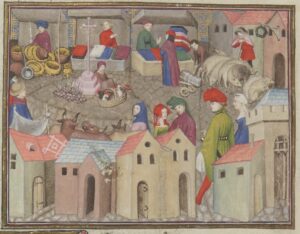 Swine as agricultural products were extremely common in the medieval townscape, but pigs are also notoriously damaging if allowed to run amuck. This article explores how local governments tried to regulate pig rearing as an integrated element in the urban space, arguing that the authorities attempted to control the movement, feeding, and slaughter of swine …
 - Pigs and pollards – medieval insights for UK wood pasture restoration
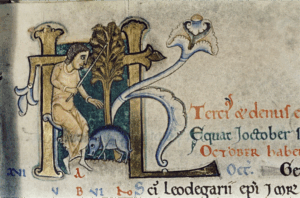 English wood pastures have become a target for ecological restoration, including the restoration of pollarded trees and grazing animals, although pigs have not been frequently incorporated into wood pasture restoration schemes. Because wood pastures are cultural landscapes, created through the interaction of natural processes and human practices, a historical perspective on wood pasture management practices …
 - The roots of the English royal forestin Anglo-Norman Studies 32: Proceedings of the Battle Conference 2009, ed. Chris Lewis, 114-128 (Woodbridge: Boydell Press, 2010) This paper challenges scholarship on the English forest that focuses on royal hunting. Through an analysis of pre- and post-Conquest Continental charters, the paper first identifies characteristics of areas called forest. It then contrasts the Continental traits to forest in William …
- Resources, Roles & Conflict: Active Resource Management in the Anglo-Norman KingdomMasters thesis, University of Houston, 2004, directed by Sally Vaughn. Contrary to the view that the Middle Ages was simply a time of rapid environmental exploitation and degradation, legal documents of the Anglo-Norman kings who reigned England and Normandy 1066-1135 reveal that medieval landholders practiced conscious management of their resources. These resources centered on woodland …
- Multi-use management of the medieval Anglo-Norman forestJournal of the Oxford University History Society, 1.1 (2004). Contrary to the common view that the Middle Ages was a time of rapid environmental exploitation and degradation, legal documents of the first three Anglo-Norman kings, who reigned over England and Normandy from 1066 to 1135, reveal that medieval landholders in their kingdom practised conscious forestry …
- Forests and forestry—EuropeIn Encyclopedia of Society and Culture in the Medieval World, vol. 2, ed. Pam Crabtree (New York: Facts on File, 2008), 473-475. Find out more about the 4-volume encyclopedia set here.
- Book reviews related to medieval natural resources or environmentReview of Harold Fox, Dartmoor’s Alluring Uplands: Transhumance and Pastoral Management in the Middle Ages, Agricultural History 89, 114–115. Review of Tom Williamson, Environment, Society and Landscape in Early Medieval England, Canadian Journal of History 49, 487-488. Review of John Aberth, An Environmental History of the Middle Ages: The Crucible of Nature, available on Reviews in History, …