
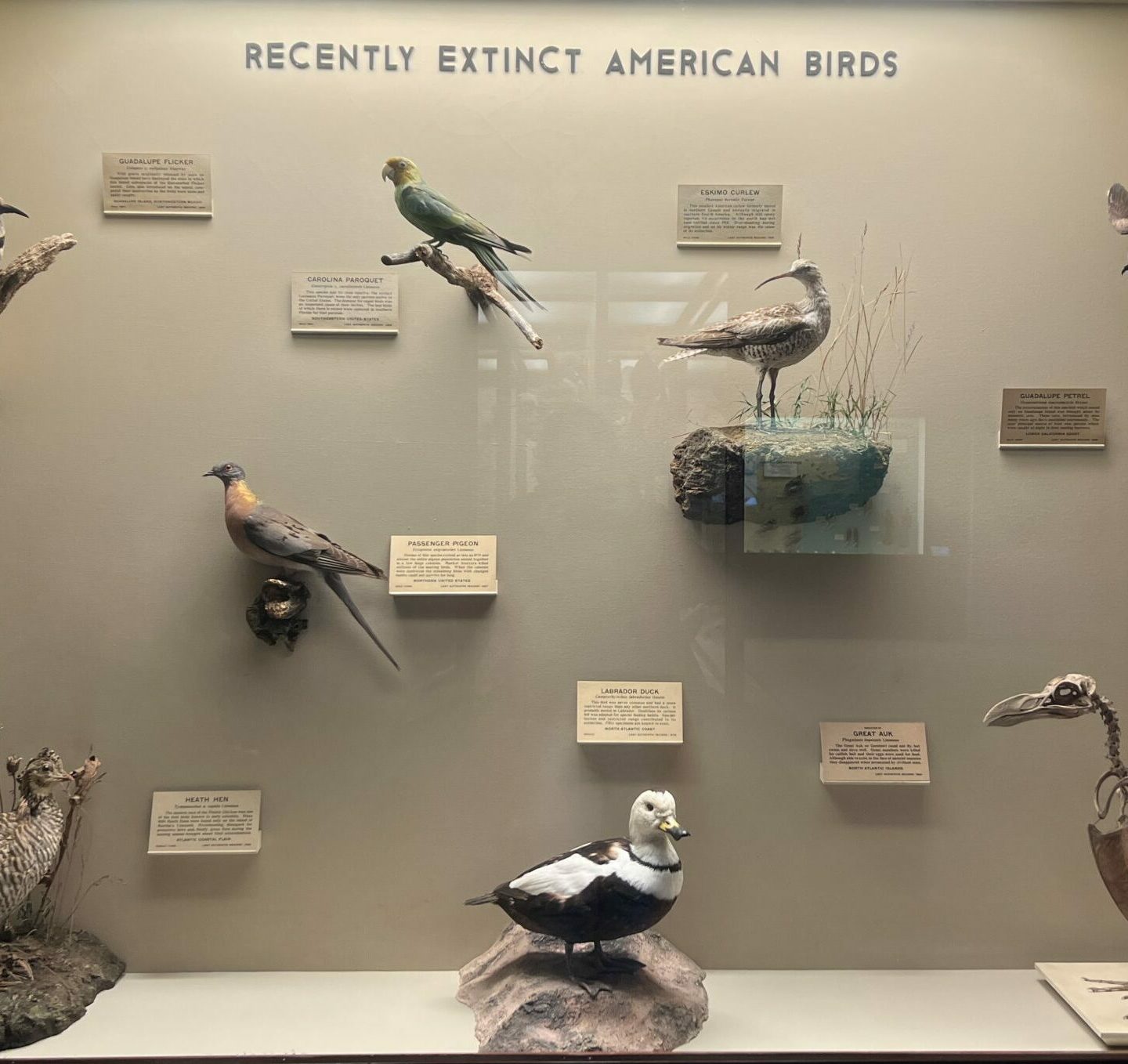

Part travelogue, part academic analysis, Ghosts Behind Glass draws readers in by narrating a well-known truth about natural history displays—how they both vary and stay the same across time and space—and provides museum visitors and practitioners alike with fresh perspectives on it. Virtually encounter the extinct in the museum halls with the help of 80 full-color photographs.
280 pages | 80 color plates | 6 x 8 | © 2025
Paper – $20.00, ISBN: 9780226842301
Published by University of Chicago Press, 2025.
Available now from local and online bookstores worldwide or direct from University of Chicago Press
“Jørgensen’s globetrotting not only collects a plethora of museum experiences for comparative analysis—itself a worthwhile goal—but facilitates the book’s most exciting moments, in museums where the ghosts of extinct species are alive in processes of culturalization.” – Theodore Anderson, NewCityLit
I am available to give book talks on Ghosts Behind Glass. Contact me via email.
Previous book talk appearances:
- Green Zone, Accelerator, Stockholm University, Sweden, 6 November 2025. Event link
- Cambridge Museum of Zoology, Cambridge, UK, 11 February 2026. Event link
- M Shed, Bristol, UK, 12 February 2026. Event link
- Oxford Natural History Museum, Oxford, UK, 13 February 2026. Event link
- UCL Grant Museum of Zoology, London, UK, 11 March 2026. Event link
Recording of book talk in the Greenhouse environmental humanities book talk series:
While it’s no longer possible to encounter a dodo in the wild, we can still come face-to-face with them in museums. The remains of extinct species—whether taxidermied, skeletal, drawn, or sculpted—stare back at us from display cases.
In this moving meditation on what’s lost and what endures, environmental historian Dolly Jørgensen visits natural history collections worldwide—from Shanghai to Philadelphia, from Edinburgh to Hobart, Australia—to understand the many ways that museums tell stories about extinction. She encounters extinct animals that are framed as cultural artifacts and as rare valuables, that are memorialized with lists, and that are brought to life through augmented reality. She draws our attention to creatures with prominent afterlives—passenger pigeons, giant moas, thylacines—as well as those that are less likely to be discussed or displayed. Throughout, Jørgensen examines the relationship between museums and the natural world, so readers can look more closely at exhibits about extinction, studying the displays for what is there, as well as what is missing. During a period of rapid species loss driven by humanity’s environmental impact, Ghosts Behind Glass asks what we can learn about our world from the presence of the extinct.